

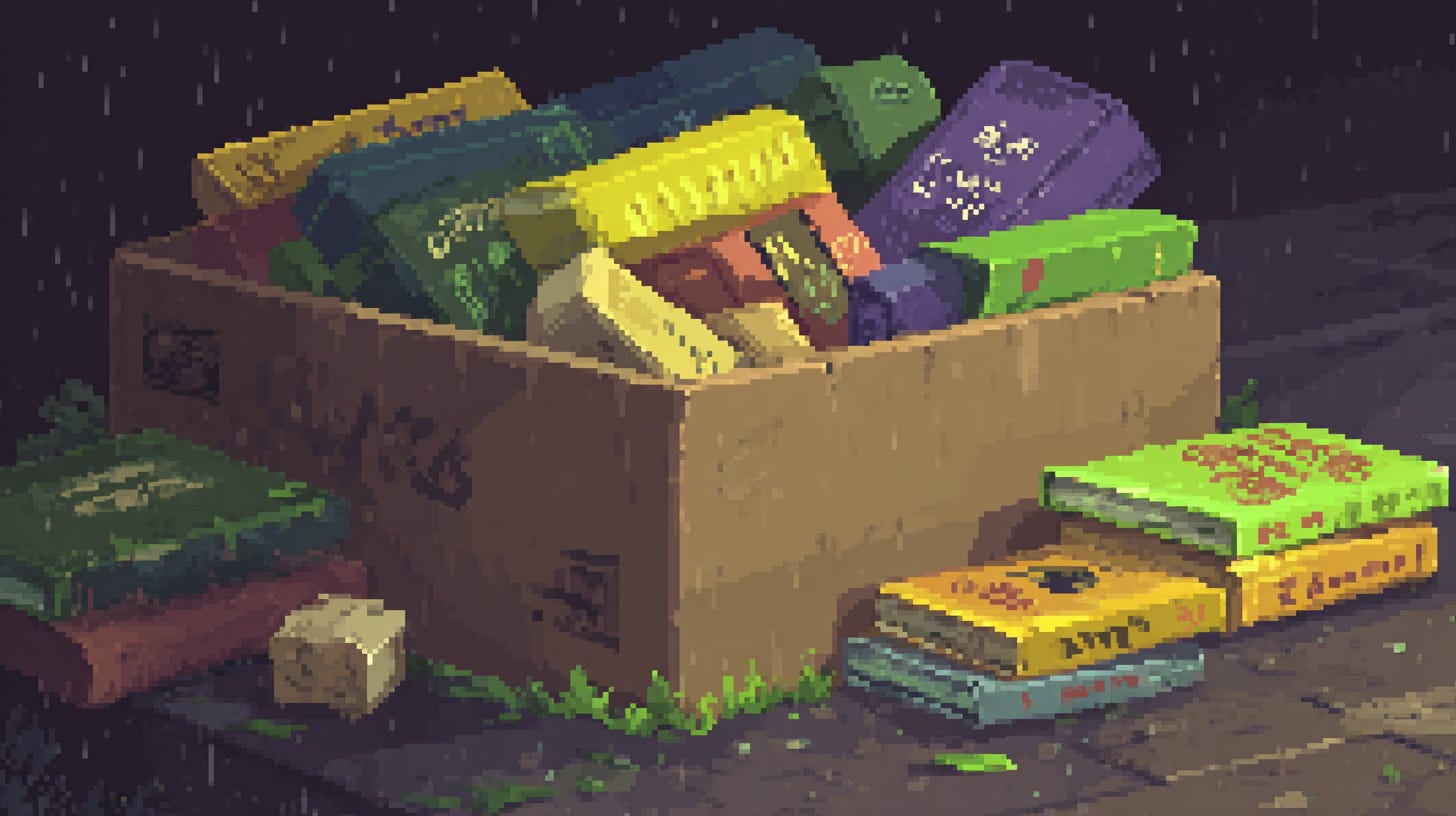
I recently started volunteering at a non-profit that takes book donations and sells them for the benefit of public libraries. The work consists mostly of sorting through donations and “culling” the books they can’t sell. People will bring in boxes of books accumulated over a lifetime. It’s like looking at a snapshot of someone’s life. For example, we received a box filled entirely with books about divorce. To be fair, people published and purchased many of these books before the Internet’s invention, when reading books on a topic was basically the only option.
I believe the boxes tell the story of fixations. A box containing books about starting a business. Did that person ever become an entrepreneur? I could see myself in that discarded pile of books, their broken spines, yellowing and dogeared pages. The truth is reading can be procrastination. We so often tell ourselves that we will do the thing, but only after we’re ready, one more book, one more class, after I finish this big project at work. The reality is we’re externalizing our anxiety, incapable of facing the uncertainty that we may fail. Or even worse, that we’re not even interested in doing the thing we tell ourselves we want to do.
It surprised me, the sheer volume of low-quality books. Future books for the culling. People regard reading as universally good, and it is, at least compared to social media. Like anything, though, there is a wide range in quality. Surely, I only read the finest and highest quality of literature, I thought. Then I saw Show Your Work by Austin Kleo, a book I own. Not to throw shade on Kleo. I enjoyed his book, and it achieves what it sets out to do, providing inspirational and actionable advice in a bite-sized package. But it hit me. I could get way more mileage out of my reading simply by focusing on quality books and cutting out all the fat.
The low-quality books I can’t stop reading are writing books, many of which I’ve written about here on this newsletter. This past week, I had started yet another inspirational book on the creative life, which particularly primed me for this realization. I was so excited when I bought it, finally the key to unlock the creative life. After a strong opening chapter, it quickly devolved into all the same conventional advice as every other book of its ilk. It feels like I keep waiting for someone to give me permission, to tell me I’m ready. Preparing properly would stop writing from being so scary, right?
Reading these books doesn’t resolve the anxiety. It defers it, like all good procrastination does. How great it would be to not have to try, to kill this resistance. George Saunders describes writing as a purely intuitive process. He lets his subconscious guide his hand, building the story one sentence at a time, often without an outline. This couldn’t be further away from my own lived experience.
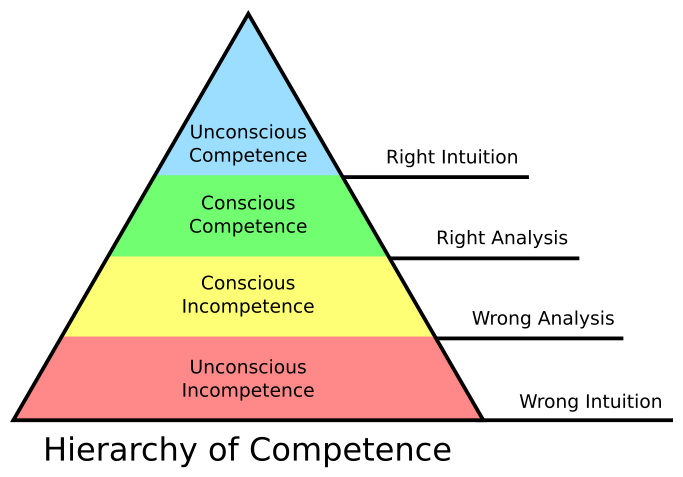
Learning about the Four Stages of Competence was helpful for me. In the beginning, it’s the unconscious incompetence stage, and through action, it eventually transitions to unconscious competence. This gave me permission to push myself. I’m still a beginner after all. Like all things, it gets easier with time. For a beginner, the hardest part is doing the thing, preferably every day. Writing is learned by doing. You can’t learn it by reading a book. Some writing books are genuinely useful. Bird by Bird by Anne Lamott comes to mind as especially useful for absolute beginners and experienced writers alike. I believe you can get 90% of the value that all writing books offer by studying and deliberately applying the lessons found in this one book.
I’ve largely come to despise the motivational category of writing books. These are to be avoided like the plague. Their inspiration is fleeting and rarely leads to concrete action. The best craft books like Stephen King’s On Writing are actually most effective for writers who already have their own process. The insight lies in comparing their method to your own and finding the universal truths they share.
All of this is to say: I’ve decided to stop reading writing books. At least, until I finish my current project, maybe forever. Instead, I’ll read books that feel relevant, in tone, content, or category to my newsletter or novel. I’ve always enjoyed reading broadly. Books are a buffet and variety keeps things fresh. Now, It feels like time to dig in deep, to learn the specific conventions of the form I’m attempting to write in.
Here’s an invitation for you take a step back and look at your media consumption diet. Not just books, you should include everything: TV, movies, social media, manga, podcasts, videogames, whatever, you get the point. Put it all in a box and hand it in to the donation center in your mind. Ask yourself you’re proud of what you see. Does the media you consume reflect your values, goals, your mission in life? Or does it reflect a need to numb the anxiety of exhaustion and overwhelm which modern society forces upon us? Build a a box the donation sorter inside your mind would be proud of.
Follow-up post: why I keep reading writing books lol