
Tech Says You're Not Special. Becky Chambers Disagrees.
Why reading cozy sci-fi in the age of AI feels like an act of resistance

I read every novel and novella Becky Chambers has ever written. All of them back to back. If you haven’t read her, the best way I can describe it is like this: it feels like therapy. Warm, unhurried, and quietly transformative in a way you don’t notice until you surface for air and realize something in you has shifted.
I didn’t expect to need it as much as I did.
Here’s what’s been bothering me. A comment on Hacker News stopped me cold: “there’s literally nothing special about the human experience.” They were writing in reaction to ChatGPT-5.4 solving a complex math problem. For the record, my human experience does not include any complex math problems, but that’s neither here nor there. Still though, this bothered me because I recognized in it the same rhetoric being spouted by tech billionaires as they attribute layoffs to AI. I find these statements to be cynical and deliberate lies, performed with the sole purpose of raising stock prices. Jack Dorsey and the Block layoffs is a recent example. For those wondering, recent layoffs a result from pandemic over-hiring, fueled by pandemic stipends and zero-interest rate spending.
Underlying the idea of the “singularity” and “superintelligence” is the assumption of Functionalism. Functionalism states that consciousness is essentially software that can run on any hardware, whether that’s a computer or a human body. What Functionalism misses, as Michael Pollan argues in A World Appears, is that the software and hardware are inseparable in the human nervous system. In our brains, information is stored in the neuronal connections, the type, and quantity of chemical receptors. What’s fundamental to the human experience is embodied sensation, felt experience.
As tech rejects humanism, I feel pulled closer to it. Which may explain why I couldn’t put down the books by Becky Chambers. What is fiction but a record of embodied sensation, a study of the subjective human experience? At the core of her work is an optimism that’s contagious. What I love about science fiction is its ability to explore big ideas. Chambers doesn’t ask if humanism is right, instead she stress-tests it, explores its boundaries and edge cases.
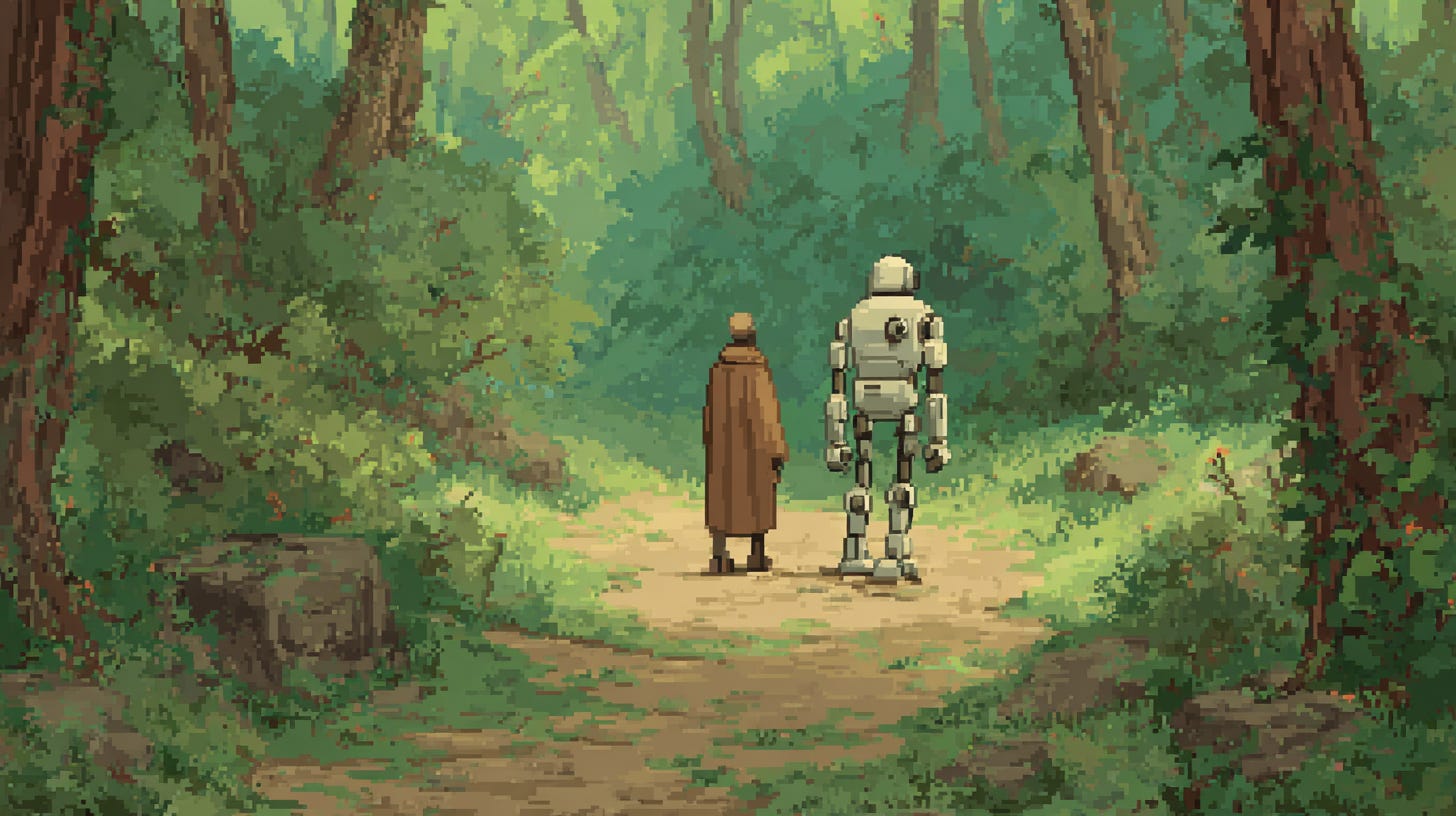
She explores subjective human experiences with non-human characters. Which is so science fiction. Like in the Monk & Robot duology, Mosscap the robot could live forever, yet it chooses to die by not repairing itself. Now, he must learn to cope with the existential dread of his own inevitable death. What’s more human than that?
Her alien species have unique family structures, designed to hold up a lens to our own. Often, examining the identity of parenthood, specifically motherhood, and asking what if a society collectively cared for its young?
But wait, you said this LLM AI stuff is anti-humanism, and yet Chambers has several AI characters in her books treated as human. There’s Mosscap, mentioned above, and also Lovey in Wayfarers book 1, who is an AI that controls a ship who has a romantic relationship with one of the crew. Well, Chambers clearly knows her stuff because her AI characters are not LLMs, they have bodies with sensations and feelings. They have thoughts of their own volition, free of prompting.
This topic is explored in Wayfarers book 2, Chambers does not set up equivalency between AI and humans. The AIs have their own distinct embodied experiences, while different from how humans experience the world, are valuable in the same way the experience of any sentient creature. Let’s not judge people for being different, but celebrate those differences and see them as a chance to grow our own understanding.
It's worth pausing on Chambers's word choice here. Her books make a distinction between “sentient” and “non-sentient” creatures, but Michael Pollan would push further and call them "conscious." In neuroscience, that's a meaningful upgrade. Sentience is just the capacity to feel. Consciousness is the whole subjective experience of being something. Chambers's AIs, with their embodied sensations and unprompted inner lives, clear that higher bar.
Book 3 of the Wayfarers series follows a society of human who live on massive spaceships. Forced to flee Earth after allowing it to succumb to environmental disaster, they built a new society with equity and sustainability as its core tenets. Again, the idea in wonderfully character-driven way. We have 5 POV characters, each coming from a unique background. How does an insular society survive the influence of the free market? How does it handle outsiders who wish to join? Chambers doesn’t ignore the complicated implications of such a society. Rather embraces them as a central form of conflict through the identity of her characters.
If there’s one thematic thread running through her work, it’s the found family. I believe this as the defining characteristic of the Cozy Fantasy genre. Unlike the power of friendship in epic fantasy, the found family is not defined by adversity, testing bonds. For example, epic fantasy needs the power of friendship to defeat the demon lord, and each character contributes their unique magic or skill. While in a found family, striving towards belonging is the whole point. Cozy Fantasy novels revolve around strangers who, despite having no good reason to do so, accept, support, and help each other. The subplots revolve around the characters’s individual barriers to achieving a sense of belonging: being rejected by their own family, being the last survivor of their species, being something considered illegal or abhorrent.
The core message is clear: survival hinges on building community. I wanted to live inside the worlds Chambers created because they’re tolerant, more forgiving places. There conflict is not caused by hate, but misunderstanding of conflicting beliefs or identity. They resolve problems by talking them out, never by violence. This place values individual embodied experience, regardless of species.
Here’s what I keep coming back to. The Hacker News commenter who said there’s “nothing special about the human experience” was wrong, but I understand the temptation. When you’re staring at a blank page, doubting whether your story matters, it’s easy to wonder if anyone needs another novel.
Becky Chambers answers that question on every page. What she’s really writing about is the same thing you’re writing about: the desperate, necessary, fundamentally human project of finding your people. Her found families don’t come together because the plot demands it. They come together because belonging is the whole point.
That’s worth writing about. That’s worth the struggle of showing up every day and putting words on the page, even when it feels inadequate. Especially then.
An LLM can generate a found family story. It can hit every beat, populate it with charming characters, and produce something that reads like the real thing. What it can’t do is mean it. It can’t write from the specific loneliness of being a person, feeling pulled toward humanism precisely because the world keeps insisting you shouldn’t bother.
But you can. And that’s the whole game.